Translate

Friday, October 25, 2013

Choices of a career woman: it's complicated!

Freedom of choice is when you can decide what you want, where you want to be and how you will get there in any aspects related to your life. Every worker has aspirations on where they see themselves in the near future and beyond. However, choices that some people have may be limited by a number of factors. This is more so if you are woman. In today's world many people believe that it does not matter whether you are a woman or man the sky is the limit. But is this really true for all women in all parts of the world? Granted the answer is no. There are several traditional values and norms that dictate what women can and are able to do. This is also true for girls in some cultures.

The story of Malala of Pakistan which hit headlines around the world tells it all. Girls may freely choice to go to school but their choice is limited in some cases by the society or culture in which they are born. For some girls the choice may be limited by the socio-economic classes in which they are born. In post-independence Africa may girl children did not go as far as high school because their parents thought it was wiser for them to pay for the boys in their households' education than for the girls. After all in their thinking the girl would marry and be taken care of by her husband in the future. These assertions have slowly changed even in the most traditional societies. Girls and boys are now given the same opportunity to go to school and attain higher education. Affirmative action by many institutions of higher learning have also contributed to attainment of higher education by girls in many developing countries.

Now back to the issue of women. In Zambia's modern society most of the traditional barriers to women's progression in life in urban set ups have been minimised. Women are free to marry who they want, have the number of children they want and own their own property. However, there are still some barriers when it comes to climbing up the corporate ladder. Despite being a signatory to the SADC Gender Protocol Zambia has not yet achieved a 30% representation of women in decision making in many sectors of society. The number of women in cabinet positions keeps on fluctuating between 2-6 at any given time since independence. The number of women Members of Parliament is also much lower in relation to men. There have been several campaigns (e.g. 50-50 campaign by the Zambia Women's Lobby Group) and projects to prepare women for election to ward councils and parliament but these have yielded little results. In the corporate world women have not fared any better. A few women have held senior positions in prominent companies and banks. Some of these include Mizinga Meru (Standard Chartered Bank Zambia Limited Managing Director), Ireen Muyenga (Zambia State Insurance Corporation Managing Director) to mention a few.

The question is why has this situation changed so little? What factors affect women's progression at individual, household, community, national and global levels? There are no simple answers. One of the key things to consider is the trade offs that have to be made with any choice. There are trade off between focusing on your career or your family and friends at a personal/individual level. This may also be a key factor at community level. To excel in any position, in the corporate, political, business or any other sector you need to be results oriented and dedicated to what you are doing. In many societies, women are regarded as the nucleus of the family. Therefore this means that whatever choices they make have to ensure that the family is not adversely affected. This means that women may have limited choices when they have a young family and more when their children are older. The limitations that comes with a young family may result in missed opportunities. This is more so in societies where there is stereotyping of gender roles.

Until recently, most cultures in Zambia reserved the role of child care for women. Children between 0-5 years would naturally be expected to be taken care of by their mothers or other women and girls in the family. However this trend is slowly changing especially in urban societies where women are increasingly working away from home. Even then most people who take up child care jobs are women. In my experience, I have only heard of one case where a young mother opted to employ a male nanny for her children. In this case the her children were male. Many mothers continue to trust female 'helpers' more when they need to leave their children in someone else's care.

Some women choose to take up part-time jobs or to work from home so that they are not deprived of the opportunity to participate fully in raising their children. Again, such a choice will affect one's ability to take on more demanding responsibilities in their career. From a family perspective choosing to engage fully in raising your kids by working from home or not having any formal job at all is an excellent thing to do. It requires a lot of self sacrifice to contribute to raising your children at the expense of your career progression. Working away from home may sometimes require working away from town and having to send days from your family. This is even more demanding in terms of the trade off involved. This can be quiet stressful for some women especially when they have young children or a baby to take care of. Some employers have flexible working conditions that allow women to travel with their infants especially when they are nursing.
 
Working women will continue to face some of these tough choices. What matters is where you are at in your career and what you think is important for you. One of the things that I always do when I am faced with tough choices is to have a serious reflection over whatever situation I am facing and look at what is best for me and the people that I care about. One thing is for sure. The first instinct is for one to base their choice on what is best for them. However, if we have to be honest we also need to reflect on how our decisions directly affect those we care about especially our family. This is where it really gets tricky and it is only when selfless interest are at play when rational people will put the interest of others before their own. It takes a lot of sacrifice to do this and more often than not most rational women will put their family first at the expense of their own climb up the career ladder. However, like anything else there are always some exceptions.
 

Monday, June 10, 2013

Removal and Reduction of Subsidies by Zambian Government: What a reaction?

The Zambian government recently announced the reduction and in some cases complete removal of some consumption and production subsidies. This has resulted in widespread reactions from various quarters of the Republic. Nearly everyday there is a headline or inside story in print and electronic media about subsidies from politicians, faith leaders and other interested parties. Subsidies have been removed on fuel, maize and  reduced on fertilisers. Government has been subsidising fuel and fertilisers for over ten years while maize subsidies were introduced in 2012 in reaction to rising mealie meal prices. Maize is a political crop and maize mealie meal political food. Elections are won and lost based on how government handles the production and marketing of maize as well as the production and sale of mealie meal. As a result, there have been a lot of reaction both from leaders from the ruling Patriotic Front and the opposition political parties over the removal and reduction of subsidies.

The ruling party and government are justifying the removal of fuel and maize subsidies by arguing that millions of kwacha that can be used to develop infrastructure development in rural areas are spent on subsidising the rich. Further, they have argued that the funds that will be saved will be used to build schools, roads, hospitals and other capital goods and services in rural areas. They have also reduced the amount of fertiliser subsidies on the Farmer Import Support Programme (FISP) where beneficiaries will be required to pay 50% on every bag of fertiliser. According to a statement issued by the Ministry of Agriculture and Livestock, the funds that will be saved will be for agriculture diversification, irrigation development, research and extension, post-harvest management and infrastructure development (Post Newspaper, 6th June, 2013, pg 17).

Opposing views argue that subsidies should not have been removed. Attempts have been made to reverse the government policy through civil pressure but this has not yet succeeded. According to these views removal of fuels subsidies will increase the production costs in the economy and therefore result in rising prices of essential commodities in the short term. They have predicted that inflation will rise and the purchasing power of consumers will be eroded in the longer term. They have further argued that the removal of subsidies on maize will push up the price of mealie meal leaving the consumers at the mercy of private milling companies. It is further argued that increased fuel prices will push up transportation costs and further increase the cost of living. Reduction of fertiliser subsidies are also predicted to directly affect the food availability at rural household level as well as national food security.

Both opposing views are valid. However, since they have been delivered with great emotion from both ends it has really confused most common Zambians who are left wondering 'what is the truth?' Subsidies like taxes are measures that are implemented by government to address market failure or to redistribute income in the economy. There is no doubt that consumption subsidies such as the ones on fuel and maize in the long run are not sustainable. However, in the short run they assist in cushioning the negative impact of high fuel or food prices at the household level. If they are well managed and well targeted they can be used as a means of supporting very poor and vulnerable households to meet their basic needs. However, blanket provision of fuel and maize subsidies is unsustainable because even individuals that can afford the commodities at prevailing real market prices are also subsidised.

It is no secret that Zambia became a food deficit nation following the complete liberalisation of the agriculture sector in the early 1990s. The policies of liberalisation fostered very rapid change that removed government involvement in input supply and crop marketing. This policy  was disastrous because the vacuum left by the collapse of the National Agricultural Marketing Board (NAMBOARD) was not immediately filled by the private sector. This prompted government to reconsider its policy and re-engage in input supply and maize marketing through the establishment of the Food Reserve Agency and the Farmer Input Support Programme in the early 2000s. Fertiliser subsidies were introduced at 50% the cost of inputs. This was raised to higher levels in subsequent years. There is no doubt that the introduction of subsidies on fertilisers resulted in some positive impact on small holder farmer productivity. Over 80% of maize production in Zambia is done by small holder farmers. Therefore, the fact that Zambia became a food sufficient and surplus country in the last 10 years points to the fact that farm productivity increased. Of course, the provision of subsidies fertilisers and other inputs could be just one of the factors. Other factors are good climate, adoption of good agricultural practices such as conservation agriculture, early planting and so on and so forth. The direct benefits at farmer level were increased food availability and income. This increased the purchasing power of rural households who were now able to afford their nutrition needs as well as invest in capital assets such as iron roofing sheets, generators e.t.c.
 
The down side to this is that even individuals that were not eligible to benefit from the FISP also benefited through corruption. Huge amounts of money meant to benefit the vulnerable were instead supporting the elite. Several attempts were made to prevent this abuse but they were not very successful. In addition, the provision of maize seed with the fertiliser promoted maize production at the expense of other crops. This lack of diversification was a serious threat to household food security in low rainfall areas and during times of poor rainfall distribution in other areas. Maize is highly dependent on water and can not with stand long dry spells. There was also very limited funding to other institutional support relevant for efficient production at farm level such as agricultural extension. These gaps affected adoption of innovations at farm level. In addition, the available  human resource was directed towards administering FISP leaving very little time for provision of technical extension services. Further, there was little investment in irrigation despite the constant threat of drought induced by climate change making many agricultural dependent livelihoods highly vulnerable to food insecurity in poor rain seasons.
 

The assurance by the MAL that savings from subsidies will be used for diversification, irrigation development, research and extension, post harvest management and infrastructure development is highly welcome. It will be a pity if these funds are not retained in the agriculture sector budgetary allocation but redirected for staff emoluments and/or other sectors. It is widely agreed that agriculture has a lot of potential of reducing rural poverty by increasing food availability and utilisation as well as income accumulation. Whatever the case one hopes that this debate on subsidies will be constructive and result in a consensus that will move our nation forward and most importantly improve the well being for the rural poor for whom it is being said this sacrifice is being made.

Tuesday, January 8, 2013

Vincentians Celebrate Christmas at St. Joseph, Makoka

On Sunday 23rd December, 2012 the Society for St. Vincent de Paul (SSVP) Conference at Chelston’s Our Heavenly Father Parish joined in the giving spirit that characterises Christmas by sharing an afternoon meal with community members around St. Joseph’s Parish in Makoka.  Makoka is one of the Out Stations in Chelston Parish situated around 15 Kilometers from the Airport roundabout in Chongwe District. Over 20 adults and 20 children from the community attended the party.

For several years now SSVP Chelston Conference has been holding annual Christmas Parties with the needy in Venter Compound at the Christian Brothers in Villa Wanga. To close off the theme of Unity and Collaboration the Conference decided to give a Christmas treaty to members of the Community in Makoka. Earlier in the year, Chelston Conference established contact with St. Joseph and the relationship has been growing from strength to Strength.

Cooking for this special event started at around 07:00hrs at Sr. Mbewe’s home situated in St. Stephen in Avondale. Various food stuffs were prepared including beef, chicken, potatoes, cabbage and Nshima. With the sky overcast with rainy clouds, Vincentians braved the rains and completed cooking to satisfaction around 12:00hrs. Thereafter, the food was ferried to Makoka using three motor vehicles in a heavy down pour. Thankfully the rains subsided by the time the entourage arrived at the Church where some community members were waiting to receive the visitors around 14:00hrs. It was a joyful occasion of sharing as Vincentians dished out the food and joined the community in taking the meal.

Tuesday, October 23, 2012

Happy 48th Birthday Zambia

Today Zambia has turned 48 years old. Zambians are still going strong, proud and free. This year many Zambians are proud of the Zambia National Soccer Team. The Team won the prestigious Africa Cup. This is the first time that Zambia is the African Soccer Champion. The Cup had evaded Zambia since independence. In 1974 and 1994 the Zambian team came close to winning the Cup by coming second in the African Championship. The nation also participated in several international competitions this year. We were represented in the London Olympics but we did not get any medals. We were also represented in the London Paraolympics but our team was disqualified for wearing the wrong attire during the opening ceremony. Imagine how such a mishap could happen. Our team 'borrowed' the national soccer team attire and the organisers of the Paraolympics were not impressed and set the team packing.

On the economic front we are not doing badly. What with our government beginning to borrow again with Zambia's improved credit rating. This year Zambia was able to borrow through Euro bonds. The government is very happy with this development saying that the increased credit rating will provide Zambia with the needed financial capital to build bridges, roads, school and other physical infrastrusture. The ordinary Zambians have received the news of the borrowing with mixed feelings. Some of the citizens have welcomed this capital injection because of  the possibility of job creation. Zambia has a very youthful population with 50% of the citizens aged below 35% and many unemployed. So any possibility of job creation is greeted with praise. However, some senior citizens are asking for caution with regard with the recent acquisition of a loan of this magnitude. Perhaps it is because they can still remember how the 7 billion Kwacha borrowed by Zambian's first government led by Dr. Kenneth Kaunda brought the country to its knees. The debt could not be repaid and it brought a lot of suffering. Zambia became one of the world's highly indebted countries and needed to be rescued by the G8 through debt cancellation. On a positive note the construction industry is booming. Many Zambians are becoming home owners through building their own houses. Others are investing in development of properties to put on rent. Construction has became the buzz word whereever one goes-at the office, pub or Church. This is very good for our young economy. It is contributing to the growth of the informal sector especially metal fabrication and block making and in a way creating self employment opportunities for talented and enterprising youths. Many absentee land owners have taken  the opportunity to subdivide their properties for sale to prospective home owners. Unscrupulous invidividuals have also taken the opportunity to illegally grab land which they sell to unsuspecting prospective developers. The construction industry is booming mainly in urban and peri-urban areas throughout the country.

On the social front local music and arts are finding their place on the airwaves once again. There are now so many singers, dancers, actors and writers that it is difficult to take count. Songs are written and released every week, day, hour or minute. Some songs are forgotten only a few minutes after release. But the most exciting thing is that those who are hard working get recognised and make a fortune from their songs. One such lucky singer was the composer and singer of 'dochi kubeba'. His song became a hit during the 2011 presidential and parliamentary election because the Patriotic Front (PF) adopted it as its main campaign song. The song was therefore 'banned' from playing on the national broadcaster airwaves by the party in government at the time. With the victory of PF the song was played on the national broadcaster, all private radio stations and at social gatherings especially weddings and kitchen parties. The composer and singer was even awarded  the 'order of distinguised service...' during the 2011 independence celebrations at State House. So if you are lucky you can actually became very famous and also earn a decent living from music and the arts.

I hope that this year's independence celebrations will be different. I am currently out of the Country so I wish you all a Happy Independence Day. In the past the celebrations have centred only around government officials, ruling party officials and civil servants' merry making. In Lusaka, if you want to participate in the celebrations then you have to get an invitation to State House or sit in front of your TV and watch what is happening at State House. Now it has even become a recognised fact that the prominent leaders of the opposition will shun the celebrations at State House. The radio and TV news bulletins will make a point of mentioning who attended the State House function and who 'boycotted'. But this has become so predictable so that it is not news anymore. One wishes that the members of the opposition will realise this and begin to attend these functions because after all it is tax payers money that is used so why not go and enjoy with everyone else.

I am sure that this year's celebration will be overshadowed by the death of the mama Betty Kaunda, the wife of First Republican President Dr. Kenneth Kaunda. She passed on a few weeks ago. These celebrations will not be done without remembering this gallant daughter of the nation. Soft spoken and kind she is an inspiration to many Zambian and mother of the nation. May Her Soul Rest in Peace.

Happy Birthday Zambia! Long live Zambia.

Sunday, October 21, 2012

South Africa seen through the eyes of a Zambian

I first came to know about South Africa and the system of apartheid obtaining there as a child in my fourth grade of primary school in 1986. During this time my class was learning about apartheid. I was given a poem to recite based on Alan Paton’s book ‘Cry the beloved Country’. At the time I was really shocked at how my black brothers and sisters in South Africa were segregated against in a land of their birth. It really shocked me more when I learnt about the plight of black activists like Nelson Mandela that were actually in Prison because of fighting apartheid. This early childhood experience really ignited interest in me to become an ardent follower of political issues in South Africa.

The fact that my country, Zambia, through our President Kenneth Kaunda was actively involved in the liberation struggle for Southern Africa made my interest to grow in understanding the South African situation. Zambia’s national television used to show films about Nelson Mandela and apartheid in South Africa. They also aired various concerts that were held around the world in Africa and Europe to put pressure on the Apartheid government to release Mandela and other political prisoners. Our president mobilised all of us to be actively involved in calling for the release of Mandela. Zambia also provided refuge to several South African freedom fighters including Thabo Mbeki and Oliver Tambo. Through television as well as various literature I become aware of the evils of apartheid and how it infringed on the freedom of movement and association especially for black South Africans. It also prevented our black brothers and sisters’ access to certain employment opportunities and made them suffer humiliation at the hands of the white South Africans. I also become aware about the decisions that had been taken by several countries to isolate South Africa so as to put further pressure on the Apartheid government to abolish this oppressive system.

At secondary school, I studied South African history. This increased my understanding on the arrival and stay of Dutch and British immigrants in South Africa. I also learnt of the early wars that took place between the British and the Boers (as Dutch immigrants were later called) in trying to get control over South Africa as well as other wars that were fought with African tribes especially the Zulu on the East Coast. Through my studies I also became aware about the deals that were made between the British and the Boers resulting into the partitioning of South Africa into British and Boer controlled territories or states and the subsequent independence of South Africa from British control and the setting up of the apartheid system of government by white South Africans. Further, I became aware of the pass system that was introduced to prevent free movement of the blacks. Studying South African history made me appreciate the difficulties that blacks were up against in gaining their freedom. However, there was so much hope in the fact that things would never be like this always. Leaders of the anti-apartheid movement, outlawed by the Apartheid government, still believed in future freedom. One could not but admire their zeal and that of their countrymen and women when they engaged in civil disobedience acts to force the government to give them greater freedom. This won them many sympathisers home and abroad, some of whom were white South Africans.

In senior secondary school I studied literature in English where I was privileged to read Alan Paton’s ‘Cry the beloved Country’. Through this book I learnt about the effects of the apartheid on an ordinary black South African as narrated by Paton as he depicted the life of Khumalo. I was deeply moved by the courage that the blacks had to protest against their oppression through mass mobilisation resulting in boycotts, strike action and street protests. It touched my heart to read and watch films re-enacting the involvement of young and old in the freedom struggle. I remember watching a film called ‘Sarafina’ in which Whoopi Goldberg starred depicting the involvement of school children in the struggle. It was really touching and inspiring to see the young people’s courage in refusing to accept to be taught in Afrikaans when they preferred English and the subsequent courage that they exhibited when they were gunned down in what became known as the ‘Soweto Massacre’.

I followed keenly the release of Nelson Mandela from Robin Island after 27 years. It was with great pride and joy that I watched with many others around the world when he walked to freedom alongside his former wife Winnie Mandela. Mandela’s walk to freedom was a triumphant occasion for those that had suffered alongside him while he was incarcerated. His lack of bitterness against the oppressors was really remarkable and unimaginable. His call for reconciliation rather than retribution was really a profound moment in history given the bloody transitions of power that have accompanied freedom in Africa. The path that Mandela and other African National Congress leaders in South Africa took after gaining independence in 1994 has really been inspirational and contributed to the important status that South Africa as gained as a leading democracy in Africa. I visited the Nelson Mandela Museum in Umutata in 2007 and I could not help but marvel at this man’s life.

Independent South Africa has become a leader in Africa especially in Southern Africa in politics and economics. My current work has allowed me to travel to South Africa several times. I have visited Pretoria, Johannesburg and Durban among other cities. I have been impressed by the way that South Africans have risen above the colour differences that separated them during apartheid and become the rainbow nation. They have also taken leadership in hosting African and global tournaments and conferences e.g. the African Cup of nations football tournament in 1996, football World Cup in 2010 and the United Nations Framework Convention on Climate Change 17th Conference of Parties (COP) in Durban last year in 2011. I attended the conference and was impressed with the organisation and leadership that South Africa has taken in the fight against climate change.

Recently, the South African Mining Industry has been overshadowed by violent protests and strikes. Maybe this signals the changing times yet again in the history of this nation and the clock continues to tick.....

Monday, July 16, 2012

Chelston SSVP visits St. Joseph, Makoka Out Station

St Joseph Out station
For a long time now the Society of Saint Vincent de Paul (SSVP) at Chelston's  Our Heavenly Father Catholic Parish, commonly known as Chelston Parish, has been planning to visit some outstations. Chelston  Parish has several outstations, many of which are rural. Today, 15th July, 2012 six SSVP members visited St. Joseph Parish in Makoka situated several kilometres east of Lusaka off the Great East Road. The SSVP members arrived at the Parish during the Sunday Mass. Fr. Miti was the Celebrant and was celebrating Mass at Makoka for the first time. He was warmly welcomed by the congregation. During his homily he urged the congregation to unite and work together and to live their Christian calling by example and not only word of mouth. 13 new members were added to the body of Christ through the rite of baptism during the mass.

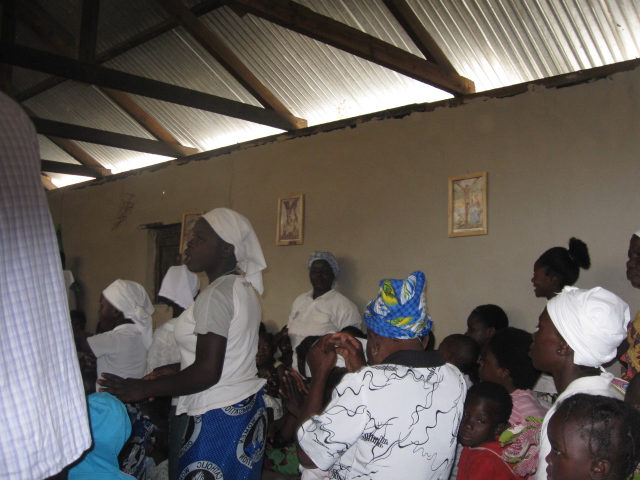
The congregation joins in singing during mass at Makoka
It was such a wonderful experience for the SSVP members to see how Mass is celebrated in this small rural outstation. All the Church members seemed to know each other and there was a warm atmosphere. The choir was really great, they played the instruments very well and the singing was very infectious. There was jubilant dancing and ululation during the gloria, offertory, hossana and thanks giving hymns. Women, children and men stood up and danced to the rhythm of the musical instruments and singing of the choir. They all joined in song and dance in worshipping the Lord. SSVP members were stuck by the difference in the active roles played by all members in singing and dance particularly in reference to the 07:00hrs 'business' Sunday Mass at Chelston Parish.

Sr. Shapole addressing Makoka parishioners
as fellow SSVP members look on
SSVP was warmly welcomed during Mass. The SSVP representative, Brother Lawrence Chitalima explained the purpose of the visit to the congregation. He said that SSVP was in the area on a fact finding mission to establish some of the challenges that the needy are facing in Makoka. After Mass SSVP members met the members of the Parish Council and other members of the congregation.  The SSVP East Deanery executive representative, Sister Daphne Shapole explained the mission of SSVP based on Matthew 25-corporal works of mercy. She urged the members of St Joseph to establish SSVP and collaborate with Chelston Conference in assisting the needy in Makoka. Thereafter, SSVP presented some pieces of clothes and pairs of shoes to the community for the needy. The pieces were counted and stored in the Parish Chairperson’s home for distribution to needy community members next Sunday.
SSVP members were later invited to the Parish Chairperson’s home where they were given refreshments before leaving for Lusaka City. All the members were very excited about the experience and thanked God for a very successful visit. It is hoped that SSVP conference will be established at Makoka and that the new partnership with Chelston Conference will grow.

To learn more about Chelston SSVP work visit our face book page, chelstonstvincentdepaul or e-mail us at chelstonstvincentdepaul@yahoo.co.uk